Myrrh
The other day I made a
bath recipe for myself using some artificial myrrh oil (real myrrh essential oil being quite expensive -- about $160 a half ounce as of this writing.) Sniffing it, it called to mind so many other spells that I've done that I realized --
this is THE smell of hoodoo.American hoodoo magic, with its blend of African, Indigenous, and European traditions, has a long history of utilizing various herbs, roots, and materials to create potent spells and rituals. One such ingredient that holds a significant place is myrrh. It is not a native plant to the Americas: commiphora myrrha is native to the Arabian penninsula and Africa. It appears often in the Bible, and because of this was adopted into European high magical traditions. As I mention in my book Conjuration, incense wasn't much used in American hoodoo till the early 20th century, when the "catalogue culture" of De Laurence and others brought to it more high magical tradition and incorporated imported ingredients into the practice. As said above, the essential oil of myrrh is very expensive, and since hoodoo is a common person's folk magic, it's been typical to use the more affordable artificial versions of its fragrance in traditional hoodoo items from the 20th century onward.
Evidently it is so popular a fragrance that almost everything winds up smelling like it, because the ingredient gets worked into just about everything at some point or another.
In the realm of modern hoodoo magic, myrrh takes on the role of a multitasking magician's assistant. It is often used as an incense to cleanse and purify spaces, allowing practitioners to create a conducive environment for their rituals. The rich and smoky scent of burning myrrh is believed to open channels to the spirit realm, inviting benevolent energies to participate in the practitioner's intentions. Just as it was presented as a gift to the divine in ancient rituals, myrrh is used as an offering to spirit guides and deities, bridging the gap between the tangible and the divine.
It has something of a "neutral" property in hoodoo that allows it to be employed in both positive and negative works. In positive spells it's often mixed with frankincense, though this ingredient too is magically neutral. In the realm of magical correspondences, myrrh has long been associated with the Moon, Saturn, and the element of Water. This multiplicity of associations highlights its versatility in spellwork. The resin is renowned for its capacity to facilitate spiritual healing, protection, and purification. In hoodoo, myrrh has emerged as a cornerstone ingredient for rituals that span from banishing negativity to calling forth benevolent spirits.
LOVE MAGIC AND RECONCILIATION: Myrrh is employed in spells to mend broken bonds and rekindle passion. Its soothing and healing properties are believed to mend emotional wounds and promote forgiveness. It is used in Cleopatra formulas, and in some Intranquility formulas. An ancient Greek love spell consisted of nothing more than praying over burning myrrh and commanding its fumes to soften the heart of the targeted person, with a prayer very similar to the intranquility prayers. To mend a broken heart, create a mixture of powdered myrrh resin, rose petals, and a pinch of sea salt. Light a pink candle, rub it with Healing oil, and dress it with this herb mixture before burning.
MASTERY AND POWER: Myrrh also is used for strength, power and wisdom. An old hoodoo catalogue promises that mixing vetivert oil and myrrh together and burning this incense is good for "personal magnetism and power."
PROTECTION AND CLEANSING: Myrrh's protective qualities are also harnessed in hoodoo magic. For purification, it can be mixed with copal and/or frankincense and burned to dispel harm and negative influences. For protection, a gris-gris of myrrh, frankincense, rue and salt can be carried on the person.
MONEY SPELLS: Myrrh's historical use as a valuable trade commodity adds to its reputation as a symbol of abundance and prosperity. You can make a lucky money mojo bag by taking a green or gold pouch and filling it with cinnamon, pyrite, and $2 bill on which you have signed your name in gold ink. Baptize the bag by dressing it with myrrh oil or reanoint it every week or smoke it in myrrh incense every week for as long as you need the bag to work.
JINXES AND HEXES: When working any jinx or hex, myrrh incense is a spiritually safe mixture to burn in your own home to enhance the work without subjecting yourself to the usual harmful influences of spicy and baneful herbs that are typical in cursing formulations.
So, if the allure of myrrh has got you spellbound, dive into the world of magic.
Check out my books for a treasure trove of traditional spells and wisdom. From affairs of the heart to financial feats, you'll have the key to unlock the potential of myrrh and other magical marvels. Remember, as you journey down this enchanting road, the wisdom of myrrh and hoodoo magic is there, ready to light up your way.
Frankincense
In older hoodoo spells this is sometimes called "white incense." Everyone knows frankincense. It's in the Christmas story, it's in every botanica and spiritual supply shop, it's the smell of Catholic Mass and Orthodox liturgy. What most people assume from all this is that it's strictly a "holy" ingredient for blessing and prayer work. But
Agrippa, in his Three Books of Occult Philosophy — one of the grimoires that filtered into hoodoo through the early twentieth-century catalogue trade — lists frankincense among both the solar suffumigations for positive operations and the "stinking" incenses appropriate for evil work. This isn't a contradiction. It tells you frankincense is one of those all-purpose resins, like dragon's blood, that strengthens whatever you put it to.
The resin comes from trees of the Boswellia genus, native to the Arabian Peninsula and the Horn of Africa — Boswellia sacra from Oman and Yemen, Boswellia papyrifera from Ethiopia. It's been traded since antiquity, shows up in the Bible alongside myrrh, and entered American hoodoo through the early twentieth-century catalogue trade that brought in most of the high magical imports. It's never grown natively in the United States.
Premium grades like Omani "Hojari" frankincense command high prices, but Ethiopian and Somali frankincense cost a fraction as much and work fine for spiritual purposes. You're making smoke, not perfume. The bag at the Indian grocery will do the job.
In hoodoo, frankincense functions as a general-purpose strengthener. Add the resin to any incense formula to increase its power. It doesn't push the work in a particular direction; it just makes it more so.
PROTECTION AND UNCROSSING: Smoking your feet in frankincense is a traditional method for removing enemy spells and protecting against future attack. This makes sense given how much foot-track magic exists in the tradition — if someone can curse you through the dirt you've walked on, it follows that protecting or cleansing your feet specifically has power. Burn the resin on charcoal and hold your bare feet in the smoke, or stand over the censer.
BLESSINGS, MONEY, AND WISDOM: Combined with myrrh and a third incense such as sandalwood or camphor, frankincense forms the traditional "Three Kings" blend. The name references the Magi's gifts, and the blend is used for blessing work, drawing money, and increasing wisdom. The proportions aren't fixed; equal parts is a reasonable starting point.
GENERAL STRENGTHENING: This is frankincense's most reliable function. Working a money spell? Add frankincense to the incense. Protection work? Add frankincense. Love drawing? Same. It operates as an amplifier rather than a specific. If you're uncertain what incense to burn for a given operation, frankincense is rarely the wrong answer.
There is also an ingredient called opoponax that is a type of frankincense. In most cases regular frankincense can substitute.
Copal
Copal is frankincense's American cousin—literally. Both come from trees in the Burseraceae family, though copal trees (Bursera and Protium species) are native to Mexico and Central America rather than Arabia and Africa. The name derives from the Nahuatl copalli, and Mesoamerican peoples were burning it in temples long before the Spanish arrived. Archaeologists have found copal residue at the Templo Mayor in Tenochtitlan and in the Sacred Cenote at Chichen Itza. The Aztecs associated it with the rain god Tlaloc and the water goddess Chalchiuhtlicue. The Maya read its smoke for divination, or cast corn grains through the smoke and interpreted the patterns where they fell.
This indigenous tradition didn't vanish with colonization: it merged with Catholicism. Mexican churches still burn copal on the Day of the Dead, the smoke said to help souls find their way back to their families. In brujeria, copal is central to limpias, the spiritual cleansings that clear negative energy from a person or space. It entered hoodoo through this Latin American connection, and you'll now find it alongside frankincense and myrrh in most spiritual supply shops.
Different grades exist: blanco (white) is considered the purest and most commonly used for cleansing, oro (gold) has a warmer scent and is often used for honoring ancestors, and negro (black) is rarer. For most hoodoo purposes, the standard white or gold copal sold in botanicas works fine.
UNCROSSING AND CLEANSING: This is copal's primary function in hoodoo. Burn it on charcoal to fumigate a home after negative events, or smoke a person who's been crossed. The limpia tradition passes directly into rootwork here—the technique is the same whether you call it brujeria or conjure.
SPIRIT WORK AND ANCESTOR CONTACT: Copal's Day of the Dead associations make it appropriate for ancestor altars and necromantic work. Burn it when petitioning the dead or making offerings at an ancestor shrine. Some workers burn it alongside Psalm 23 recitation.
PURIFICATION BLENDS: Copal mixes well with frankincense and myrrh for general purification incense. It can also be added to other blends to strengthen and focus their cleansing properties.
Dragon's Blood

Is it blood from Dragons? No.
Dragon’s blood resin is a vibrant red substance that has captivated cultures for centuries due to its striking color and wide range of uses. Contrary to its mythical sounding name, dragon’s blood does not come from dragons but from various species of plants, such as calamus draco and dracaena cinnabari. These plants are typically found in tropical and subtropical regions, such as Southeast Asia, Africa, and parts of South America. The resin is harvested by making small incisions in the bark or stems of these plants, allowing the sap to flow and harden into resin.
Each plant genus produces a slightly different variety of dragon’s blood with unique characteristics. The Dracaena cinnabari tree, found on the island of Socotra off the coast of Yemen, produces one of the most famous varieties, known for its use in ancient rituals, medicine, and art. The process of harvesting and processing the resin is often labor-intensive, requiring careful extraction to maintain the health of the plant and ensure a sustainable yield.
Dragon's blood resin can be burnt by itself as an incense mixture. However, it doesn't have much of a fragrance on its own; though it will smoke plenty, and scent isn't necessarily the way that magical properties are conveyed in the traditional practices that use incense. I would call the smell of true dragon's blood resin "plastic-like" — not a smell of burning plastic, but that faint odor that clings to an item made of plastic.
If you are burning dragon's blood incense which has a strong perfume to it, it is either adulterated or is a fake fragrance blend. Many incense brands sell alleged "Dragon's Blood" incense which contains none of the real resin and is just an artificial fragrance mixture chosen by the company. Some incense makers don't even realize that it's a true herbal ingredient, and sell it just as a suggestive name like "Angel Wings" or "Mystic Nights."
In hoodoo magical practices, dragon's blood is admired for its red color, which is used in spells of power, love, protection and sometimes uncrossing. It's also used to bring back a lost lover, on the word play of dragging (dragon) the person back into the relationship. For this reason it pairs well as an incense
with Intranquility Spells and rituals of the type.
Dragon's Blood Ink
In 2011 I had the opportunity to work, for the first time, with dragon's blood ink. Now,
I typically practice in the hoodoo tradition, where fancy magickal inks aren't really used (being told to use red, blue or black ink is traditionally as complicated as it gets.) But, on this occasion I was doing a spell from
The Black Pullet and while it didn't specify to use any particular kind of ink, it seemed like the appropriate place to try one out.
Now, it may come as no surprise that "dragon's blood" does not come from a dragon. Rather, it's the name of a resin that has a reddish color. Presumably it was thought at one time to come from dragons; or perhaps the plant in former times had a name that sounded similar to "dragon" and was corrupted by folk etymology.
I mixed the ink by myself from the genuine resin, and laid it down with a brush instead of a pen. I was surprised that the ink came out a rather brownish color, rather than the red tone dragon's blood appears to have when pulverized, and that fake dragon's blood talismans are usually printed in (I had always assumed they at least were attempting to match the hue of the real thing.)
Here is the recipe for dragon's blood ink which I used:
2 parts dragon's blood resin
1 part gum arabic
17 parts alcohol (pure -- use Everclear or 100% rubbing alcohol)
Finely powder the resins and combine thoroughly with the alcohol. You may need to let the mixture sit a while for the resins to properly blend into the alcohol, before it is ready.
This stuff dries out fairly fast, or at least it did when I made a tiny batch like I did. I think most commercial Dragon's Blood formulas have some water mixed in to keep down the evaporation, and I suppose you could do that here (though you'd probably want to do it AFTER it's blended into the alcohol.)
Alternately, you can just let the mixture dry out like I did, and save the leftover resin powder for a batch of
Agrippa's Sun incense.Camphor

Camphor holds an unusual place in the hoodoo tradition, valued for its spiritual power to be employed toward multiple purposes. This crystalline substance, derived from the camphor laurel tree (Cinnamomum camphora), has been integrated into folk magic practices for generations, bridging Old World herbalism with New World spiritual innovation. Like many hoodoo resins, it has never been natively grown in the United States.
It also has a special place in my heart, being the ingredient that brought me into hoodoo during a search for camphor soap.
Nowadays much of the camphor you find is synthetic. It is made from turpentine and sometimes paraffin. If you're buying your camphor shaped in little blocks, it's probably this type. Natural camphor comes in a milky white crystal form, and is food-safe in small quantities. You can often find it at Indian groceries because it's used to flavor desserts, and is also burnt in puja offerings. (It is for one said to be a favorite fragrance of the goddess Kali.) The synthetic type evaporates when left out in unsealed containers.
There's little reason one needs to choose one or the other since synthetic fragrances are very commonly used in modern hoodoo, and many practitioners find it perfectly satisfactory. But some think it's better to use the natural version if it's available.
There are three main uses of camphor in hoodoo magical traditions:
cleansing and protection
This is the most common way to employ camphor in modern magic. It can be used on its own or combined with other things for uncrossing and purification. Putting a camphor square in each corner of the room is traditional cleansing and protection technique. Washing with camphor soap is good for uncrossing.
A suggested purification ritual for those who don't want to burn incense is to put out a dish of Florida Water with a little camphor in it, and let the scent clear harmful energies from the room. It is also an ingredient in traditional Four Thieves Vinegar. A recipe for a protective mojo is made from a white bag filled with parsley, spearmint, garlic and camphor, fed with holy water.
psychic work
In Wicca and other European traditions it is connected with the moon due to its bright white color, and is used for Moon magic and consecration. By extension it can be used to increase psychic ability and occult powers. One recipe for divination incense uses camphor, dittany, damiana, Solomon's seal root, and orris root mixed into incense base, burned in the room while performing such rites. This for enhancing ability.
It was also at one time considered a hallmark of New Orleans Voodoo practitioners to wear a square of camphor from a string around their necks. A recipe for a fortune telling jackball is recorded, made from camphor and lodestone.
domination work
Perhaps by extension of its psychic reputation, camphor is sometimes said to increase the mind-controlling power of incense blends such as Commanding or Bend Over when it is mixed into them. In like manner, a little bit of camphor oil mixed into a domination perfume like Bend Over when you wear it, will increase its power. A Hyatt informant advised mixing it with Chewing John for success in a job interview.
It's especially useful in combination with its purifying power as something to "clear away" undesirable thoughts from the target.
Palo Santo
Palo santo has a guilt complex attached to it. Browse any witchcraft forum long enough and someone will scold you for burning it — the trees are endangered, you're contributing to habitat destruction, find an alternative. This is well-meaning but mostly wrong. The palo santo sold commercially in the United States is virtually all farm-raised, not wild-harvested. Bursera graveolens is cultivated in Ecuador and Peru specifically for the spiritual supply market. If that market dries up because everyone's been shamed into not buying it, those farmers aren't going to let their land return to Ferngully. They're going to bulldoze the trees and plant something else people will actually purchase. Not buying palo santo doesn't save trees — it removes the economic incentive to grow them.
The wood comes from a tree native to South America, related to frankincense and myrrh (all three are in the Burseraceae family). The name means "holy wood" in Spanish, and it's been used in South American folk magic and indigenous practices for centuries. It entered North American hoodoo relatively recently, primarily through contact with brujeria and other Latin American traditions, and you'll now find it in most spiritual supply shops alongside the more traditional resins.
Its main application is cleansing and uncrossing. Papa Jim advises bathing in an infusion of the wood as an uncrossing bath. You'll also find palo santo sticks included in
commercial smudging kits, usually alongside white sage — light the end, let it catch, blow it out, and use the smoke to cleanse a space or person.
Benzoin
If you've run across "benjamin" or "benedict" in old hoodoo formulas and recipes, you're looking at benzoin. The name corruption happened naturally: the Arabic lubān jāwī ("frankincense of Java") became the French benjoin, then the English "benjamin" or "gum benjamin," and eventually the modern "benzoin." All the same resin from Styrax trees in Southeast Asia.
The resin has a warm, sweet, vanilla-like scent that makes it popular in church incense. Orthodox and Catholic congregations burn it regularly. This gave it similar credibility to frankincense when it entered hoodoo through the import trade. It never grew in the Americas; the trees are native to Sumatra, Java, Thailand, and surrounding regions.
Two grades dominate the market: Benzoin Siam (from Styrax tonkinensis, grown across Thailand, Laos, and Vietnam) and Benzoin Sumatra (from Styrax benzoin). Siam benzoin tends lighter in color and more refined in scent; Sumatra benzoin runs darker with a heavier, earthier character. Either works for spiritual purposes, though some workers prefer Siam for love and attraction work and Sumatra for heavier protection.
BRING BACK LOVER AND RECONCILIATION: Benzoin functions as a drawing powder in love work, particularly for reconciliation and returning a straying partner. Its sweet, warm quality is meant to sweeten feelings and draw the target back. It can be burned as incense while working candles for reconciliation, or powdered and added to mojo bags, sachets, or dressing powders.
PURIFICATION AND PROTECTION: Mix benzoin with camphor and burn it in each room while performing a ritual house-cleaning to clear out evil messes—this combination is traditional for cleansing a new home before moving in. The sweet scent "lifts" the atmosphere while the camphor cuts through negativity.
GENERAL BLESSING AND POSITIVITY: Benzoin's warm, pleasant character makes it appropriate for blessing work and creating a positive atmosphere. It can be added to incense blends meant to invite good spirits or burned simply to make a space feel welcoming and spiritually clean.
Aloeswood
Aloes, agarwood, also known as oud, oodh or agar, is a dark resinous heartwood that forms in Aquilaria and Gyrinops trees (large evergreens native to southeast Asia) when they become infected with a type of mold. It is a fragrant wood, valued in antiquity for its pleasing smell and recommended in magical textbooks for operations connected with the sun. The resin embedded wood is valued in many cultures for its distinctive fragrance, and thus is used for incense and perfumes.
One of the main reasons for the relative rarity and high cost of agarwood is the depletion of the wild resource.
Bitter aloes, made from
a different plant, is a purgative drug and therefore a symbol of spiritual cleansing, purgatory.
Sandalwood
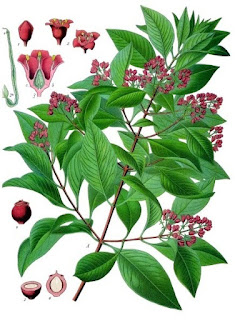
Sandalwood is the name of a class of fragrant woods from trees in the genus Santalum. The woods are heavy, yellow, and fine-grained, and unlike many other aromatic woods they retain their fragrance for decades. As well as using the harvested and cut wood, essential oils are also extracted from the woods for use. Both the wood and the oil produce a distinctive fragrance that has been highly valued for centuries. Consequently, the slow-growing trees have been overharvested in many areas, causing the price of this important wood to skyrocket. Many herb shops now only sell Australian Sandalwood instead of true White Sandalwood traditionally called for, because it is more abundant. Several species of plants are traded as "sandalwood." Within the genus Santalum alone, there are more than nineteen species. Traders will often accept oil from closely related species, such as various species in the genus Santalum, as well as from unrelated plants such as West Indian Sandalwood (Amyris balsamifera) in the family Rutaceae or bastard sandalwood (Myoporum sandwicense, Myoporaceae). However, most woods from these alternative sources will lose their aroma within a few months or years.
The plant does not grow native in the US. Therefore, sandalwood is not one of the most traditional of
hoodoo ingredients, but it has been long used in old-world magical spells and perfumes, and its usages carried over from this. In current practice, sandalwood or the essential oil of sandalwood is used in hoodoo style magic to bring blessings and purification. In
planetary magic, it is usually considered to be a Mercury herb, also making it appropriate for aiding mental clarity, speed, communication, knowledge, commerce, transport and travel.
Pine Resin
Here's something you won't read about most hoodoo resins: pine actually grows in the United States. You can harvest it from your own backyard if you've got the right trees, and Appalachian and Southern folk magic traditions have used it for generations. This makes it one of the most traditional American ingredients in the rootworker's cabinet.
Pine resin (also called pine rosin or colophony) is the sticky sap that bleeds from pine trees when the bark is damaged. Left to harden, it becomes a brittle, amber-colored solid that burns with a sharp, clean, forest smell. You can purchase it from woodworking suppliers, some apothecaries, or harvest it yourself from any obliging pine. If you're gathering your own, look for the hardened chunks where sap has pooled and dried — scrape it off with a knife and store it in a jar. You can use the liquid or semi-hard sap but be prepared for a sticky mess if you do (keep Lava soap and something like Goo Gone on hand for cleanup.)
Pine has three main uses in hoodoo:
CLEANSING AND PURIFICATION: Pine's sharp scent has a "cutting" quality that makes it natural for clearing out negativity and stagnant conditions. Burn the resin on charcoal to fumigate a home, or add it to floor washes. Pine-Sol became a popular hoodoo cleaning product for this reason: the pine scent does double duty.
MONEY DRAWING: This is sympathetic magic by wordplay. Pine is an evergreen (ever green, always green, always money.) The logic is the same as using Five Finger Grass for grabbing opportunities. Burn pine resin while working money spells, add it to money-drawing incense blends, or incorporate it into mojo bags for steady income.
COERCIVE LOVE: If you want someone to "pine away" for you.


