Many of the recipes and tricks in The Spellbook of Marie Laveau/Petit Albert say to use an alembic to distill things. Here is a photo of a historical specimen:
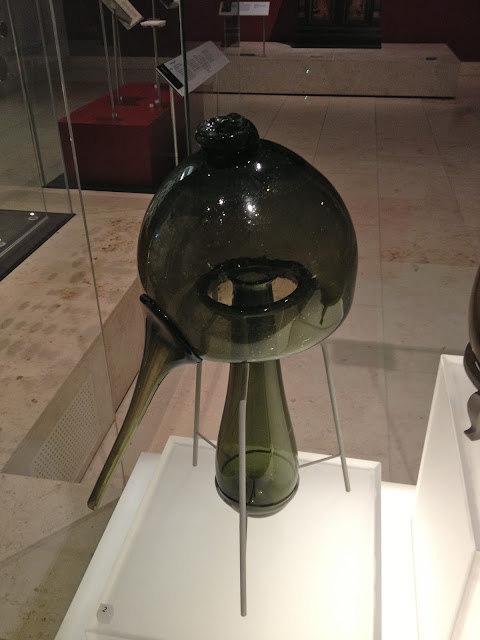
The Alembic (also alambic, alambique and alembick; Latin: Alembicus) or distilling helmet, also called caput Mauri, Capitellum or Galea in alchemy, is an attachment on distillation vessels for the separation of substances by heating and subsequent cooling (distillation). Similar to the retort, the Alembic has a long, side-downpipe through which the distillate consisting of rising vapors liquefied (condensed) by air cooling can drain into a collection vessel (the template). However, the bottom of the Alembic is open so that it can be put above the actual distillation flask.
The name Alembik is derived from Latin alembicus (also alambicum) from the Arabic al-anbiq (Arabic الأنبيق), which in turn originates from the Arabic article al and the Greek word ambyx (ἄμβυξ) for vessel (later ambīk, "cup, pot, distillation vessel").
The process of distillation was already used by the Egyptians and in ancient Greece to produce essential oils. Originally, plant parts were heated in an open kettle, over which wool was spread in several layers on a grate. The rising vapors condensed in the wool layers, and the water-oil mixture could then be pressed out and separated.
According to Edmund von Lippmann, the description of a simple distillation apparatus, consisting of a filling vessel, discharge pipes, and a receiver (collection vessel), is already found in the writings of Mary or Maria the Jewess, who presumably lived sometime between the 1st and 3rd centuries in Alexandria. The device is known as the Tribikos and probably consisted of several clay or glass vessels connected by copper tubes. The lower one was used to heat a liquid, whose vapor rose into an upper clay vessel. From there, the condensate flowed through three copper tubes into three glass vessels.
The Arabs refined the distillation process—probably in the 9th or 10th century—by inventing the Alembik, adding a helmet-like lid with an inner collection channel for the condensate above the kettle. The steam rising from the heated liquid condensed on the walls of the attachment, the condensate collected at its lower edge, and flowed through the spout into a collecting vessel.
Distillation was one of the fundamental processes of medieval alchemy. Paracelsus compared creation to the work of an alchemist, in which God created the world from the elements of chaos through distillation, calcination, coagulation, and sublimation.
In hermetic writings, the Alembic, which served to distill the elixir, ether, or essence of a substance, was seen as a miniature cosmos, in which the distilled substances ascended from the earth to the sky. Improved apparatuses used water cooling. Either the cooling pipe was extended and passed through a barrel of cold water, or a large water bowl surrounded the distillation helmet. This apparatus was called a Moor's head (Latin: caput mauri, French: tête de maure) because the cooling bowl looked like a turban.

The Alembic (also alambic, alambique and alembick; Latin: Alembicus) or distilling helmet, also called caput Mauri, Capitellum or Galea in alchemy, is an attachment on distillation vessels for the separation of substances by heating and subsequent cooling (distillation). Similar to the retort, the Alembic has a long, side-downpipe through which the distillate consisting of rising vapors liquefied (condensed) by air cooling can drain into a collection vessel (the template). However, the bottom of the Alembic is open so that it can be put above the actual distillation flask.
The name Alembik is derived from Latin alembicus (also alambicum) from the Arabic al-anbiq (Arabic الأنبيق), which in turn originates from the Arabic article al and the Greek word ambyx (ἄμβυξ) for vessel (later ambīk, "cup, pot, distillation vessel").
The process of distillation was already used by the Egyptians and in ancient Greece to produce essential oils. Originally, plant parts were heated in an open kettle, over which wool was spread in several layers on a grate. The rising vapors condensed in the wool layers, and the water-oil mixture could then be pressed out and separated.
According to Edmund von Lippmann, the description of a simple distillation apparatus, consisting of a filling vessel, discharge pipes, and a receiver (collection vessel), is already found in the writings of Mary or Maria the Jewess, who presumably lived sometime between the 1st and 3rd centuries in Alexandria. The device is known as the Tribikos and probably consisted of several clay or glass vessels connected by copper tubes. The lower one was used to heat a liquid, whose vapor rose into an upper clay vessel. From there, the condensate flowed through three copper tubes into three glass vessels.
The Arabs refined the distillation process—probably in the 9th or 10th century—by inventing the Alembik, adding a helmet-like lid with an inner collection channel for the condensate above the kettle. The steam rising from the heated liquid condensed on the walls of the attachment, the condensate collected at its lower edge, and flowed through the spout into a collecting vessel.
Distillation was one of the fundamental processes of medieval alchemy. Paracelsus compared creation to the work of an alchemist, in which God created the world from the elements of chaos through distillation, calcination, coagulation, and sublimation.
In hermetic writings, the Alembic, which served to distill the elixir, ether, or essence of a substance, was seen as a miniature cosmos, in which the distilled substances ascended from the earth to the sky. Improved apparatuses used water cooling. Either the cooling pipe was extended and passed through a barrel of cold water, or a large water bowl surrounded the distillation helmet. This apparatus was called a Moor's head (Latin: caput mauri, French: tête de maure) because the cooling bowl looked like a turban.