Magic Books by Talia Felix

Sisame de Laponie, the Mysterious Ingredient in the Occult Hand of Glory -- What Is It?

dead man's hand hand of glory magic
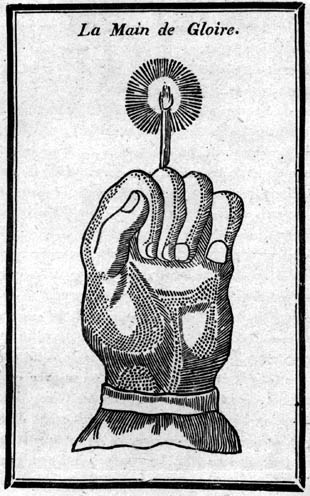
In the Petit Albert, the recipe for the Hand of Glory is as follows:

ON THE HAND OF GLORY, WHICH IS USED BY TREACHEROUS THIEVES, IN ORDER TO ENTER HOMES BY NIGHT WITHOUT HINDRANCE. I confess that I have never tested the secret of the Hand of Glory; but I have three times assisted in the convicting of certain miscreants who confessed under torture to have used the Hand of Glory in the thefts they had committed; and when during the interrogation they were asked what it was, how it was acquired, and what it was used for, they responded, firstly, that the purpose of the Hand of Glory was to entrance and make immobile those to whom it is shown, after which they become unable to stir, such as if they were dead; secondly, that it was the hand of a hanged man; thirdly, that it must be prepared in the following manner: One takes the right or left hand of a hanged man who has been left to the dogs; one wraps it in a piece of a funeral shroud, in which one presses it well so as to squeeze out the bit of blood which remains in it; then one places it in an earthenware container with some green vitriol, saltpeter, salt, and long pepper, all well pulverized. One leaves this resting in the pot for a fortnight, then having removed it one exposes it to the intense sun of the dog days of summer, until such point as it has become quite dry; and if the sunlight is not adequate, one places it in an oven fueled with ferns and vervain; then one composes a special candle with the fat of a hanged man, virgin wax and sisame de laponie, and it is set into the Hand of Glory like it is a candle holder, so that it grips the burning candle; and in all the places where one goes with this wretched device, so are people rendered immobile; and when after this they were asked if it did not have some remedy for the neutralizing of its trick, they said that the Hand of Glory became useless and that thieves could not make use of it if one rubbed the threshold of the door of the house, or of any other place through which they might enter, with an unguent composed from the gall of a black cat, fat of a white hen and the blood of an owl, and it was required that this confection should be made in the dog days of summer.

The question that has boggled minds for ages is what on earth Sisame de Laponie could be. Without it, one is unable to produce the charm.

The most obvious way to translate the phrase is "Sesame of Lapland." The sesame seed itself carries significant symbolic weight in magic and folklore. In Arabic and Persian traditions, sesame seeds are linked to the supernatural, particularly known in the west through the phrase "Open Sesame" from Ali Baba and the Forty Thieves, where the seed functions as a metaphor for unlocking hidden treasures. While the connection to sesame in this context might seem tenuous, the association with (un)locking -- or in this case, immobilizing -- could be why the ingredient was chosen. But, because Lapland (modern Finland) does not possess a suitable climate for the growing of the plant sesamum indicum, it can be assumed the object in question is not a literal sesame that grows there. It may in that case be another type of oily seed. 

There are those who argue that the phrase refers to manure and should be read as "sisame de la ponie" (pony's sesame, i.e. turds) but I would say that this is unlikely since pony -- despite ultimately having been derived from French poulain ("foal") -- was not a word in use in the French language at the time of the Albert's composition (Modern French poney is a loan-word from English.) 

If one is to argue for a non-standard reading of the word laponie, I myself would argue that it is derived from the Old French lape, meaning a burr, or sometimes the plant burdock in particular, whereby it could be read as something like "sesame of burr-like nature." (lape + diminutive suffix -on : yielding lapon "little burr" or "burr-like" with suffix -ie used to distinguish action or nature.) Another possibility is the word is a corruption, just like the Hand of Glory itself (Fr: Main de gloire) is a corruption from the word mandragore -- literally "mandrake" but really a word used to indicate many kinds of magical objects. Such corruptions were very commonplace in the era of handwritten manuscripts, where through poor penmanship or damage to the MS a word could be garbled and thus causing the next person who wanted to copy it to be unable to read what was really intended. (Compare the term athame, a modern witchcraft word derived from mistranscription of Latin artavus "pen knife" in Solomonic Grimoires.)

It could also simply be a trick, either by the book's author or by one of the thieves that supposedly had used the Hand of Glory, to prevent anyone from actually being able to perform the spell, by listing a non-existent ingredient.

My translation of the full Petit Albert is available in paperback here. This is the same text as the much more costly Hadean Press version, just available in paperback.
Want professional spellcasting? Visit Hoodoo Online for services, or browse my books on Amazon.

Popular posts from this blog

Magical Hoodoo Baths - The Original Hoodoo and Voodoo Bath for Luck, Love and Success

One beginning in the tradition of hoodoo should know about the importance of baths. They are vital tools in hoodoo work and cannot be dispensed with.  Many people nowadays don't have bathtubs, and some adaptation can be achieved by way of showers. Other people use a large bowl or bucket of water to pour on themselves in place of a spiritual bath. In olden times, and also in some places today where water on tap isn't common, people will perform their spiritual baths in a river or pond outdoors.  A spiritual bath is similar to a regular bath, but with certain key differences. Spiritual baths are not meant primarily for physical cleansing and so washing items like soap might be taboo depending on the exact bath type. However there are some types of magical bath that do use the multitasking property of soap or other cleansers, and in those cases the cleaning aspect is appropriate to the work. There is some controversy around washing the hair in a spiritual bath. Many people don...

The Ultimate Hoodoo Herbal Incense Guide

 Myrrh The other day I made a bath recipe for myself using some artificial myrrh oil (real myrrh essential oil being quite expensive -- about $160 a half ounce as of this writing.) Sniffing it, it called to mind so many other spells that I've done that I realized -- this is THE smell of hoodoo. American hoodoo magic, with its blend of African, Indigenous, and European traditions, has a long history of utilizing various herbs, roots, and materials to create potent spells and rituals. One such ingredient that holds a significant place is myrrh. It is not a native plant to the Americas: commiphora myrrha is native to the Arabian penninsula and Africa. It appears often in the Bible, and because of this was adopted into European high magical traditions. As I mention in my book Conjuration , incense wasn't much used in American hoodoo till the early 20th century, when the "catalogue culture" of De Laurence and others brought to it more high magical tradition and incorpor...

Occult Mysteries of Candle Omens: The Surprising Truth About Spellcasting Success and Misleading Signs

One of my most consistently popular posts on this blog is the Candle Omens post, indicating many many people want to know about how to read omens for their spells through the augeries of wax or flames. When I perform spellcasts for clients , if the work I have done involved a candle spell, I will usually report on the condition of the flames, smoke or interesting activity with the wax.  And yet, how valid is this for determining spell outcome? In my own experience, I have had candles that burned badly result in brilliant successes, and candles that burned well lead to dud results.  The first thing to keep in mind about reading omens in candles it that it really shouldn't be done if you are inexperienced in candle burning, OR if you are using an unfamiliar brand of candles . In both cases, it can lead to falsely assuming a normal event is something abnormal or significant. For example, there is a particular type of pullout candle which I have to go out of my way to ...

Perfume, Cologne, and Its Use In Hoodoo

The original recipe for cologne was reputedly given to St. Elizabeth of Hungary by an angel -- the concoction was known as "Hungary Water" and was used primarily as a medicine, rather than just a mere fragrance. Charles Godfrey Leland remarked that it therefore was appropriate hoodoo practitioners would use such a substance for feeding their conjure bags and other talismans. The term cologne actually comes from a later preparation, Cologne Water (named for the German city.) The original Cologne Water is a spirit-citrus perfume launched in 1709 by Giovanni Maria Farina (1685–1766), an Italian perfume maker from Santa Maria Maggiore Valle Vigezzo, Italy. In 1708, Farina wrote to his brother Jean Baptiste: "I have found a fragrance that reminds me of an Italian spring morning, of mountain daffodils and orange blossoms after the rain". He named his fragrance Cologne Water, in honour of his new hometown. The Original Cologne Water composed by Farina was used on...

Sugar and Sweetener - Vital Ingredients for Traditional Hoodoo and Witchcraft Magic

Sugar spells are everywhere these days. People know you can “sweeten someone up,” and if you poke around online for five minutes, you’ll find love spells that ask you to write a name on a paper and put it in a jar with sugar, honey, syrup, or a piece of candy. It’s not just popular — it’s practically its own genre. But the real history of sugar in hoodoo is a little deeper, and as always, a little weirder. Traditionally, sugar was used to sweeten someone toward you — whether for love, kindness, better treatment, or even to grease a boss’s attitude at work. You’ll find older spells that use sugar to make a judge lenient or to keep someone from being angry. What’s rarely mentioned outside the tradition is that the type of sugar used could be significant. Yes, really. In older hoodoo practice, sweeteners were sometimes matched to the race or skin tone of the person being targeted. Molasses - thick and dark, was typically used if the person was Black. White sugar - for a white person. Hon...